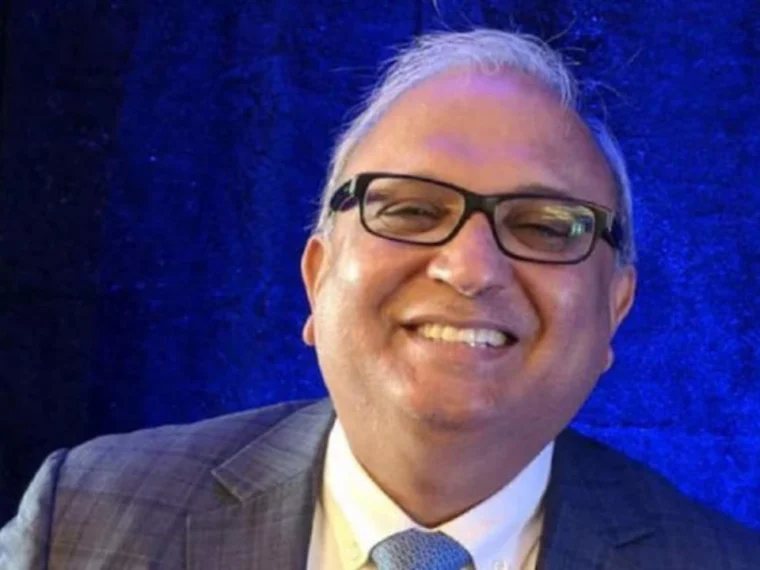
Concerns over US President Donald Trump raising global tariffs to 15 percent may be overstated—at least from India’s perspective. Veteran investor Samir Arora, founder of Helios Capital, believes that India’s competitive standing in global trade remains largely unaffected despite the political turbulence in Washington.
Trump recently increased the baseline global tariff rate from 10 percent to 15 percent. The move followed a 6-3 ruling by the Supreme Court of the United States, which declared that the president could not unilaterally impose and modify tariffs under the legal framework he had relied upon. In response, Trump signalled that his administration would explore alternative statutory routes to implement “legally permissible” tariffs, including mechanisms that require investigations by the Commerce Department.
‘Not a Unique Disadvantage for India’
In a detailed eight-point post on X, Arora argued that India is not being singled out by the tariff hike. More than 90 countries that were previously subject to a 10 percent tariff now face the same 15 percent rate. This group includes major US trading partners such as Australia, the United Kingdom, Singapore, and the United Arab Emirates.
According to Arora, tariffs create meaningful economic pressure only when countries are treated differently. If nearly all nations face a uniform rate, the relative competitive balance remains largely intact.
“Tariffs have power if you can pitch one country against another. If all countries have 15 percent (or 10 percent), how does it matter much — this becomes more of an internal tax issue for the US,” he explained.
In essence, Arora’s argument is that a uniform tariff structure minimizes distortions in global competitiveness. If India’s exporters are subject to the same rate as their global peers, the comparative disadvantage is limited.
Limited Duration, Political Uncertainty
Another key point highlighted by Arora is the temporary nature of the 15 percent tariff framework. As currently structured, the rate is set for a 150-day period. Any extension beyond roughly five months would require approval from Congress, introducing an additional layer of political uncertainty.
This means that while the announcement has sparked headlines and market jitters, the longer-term trajectory of US trade policy remains unclear. Legal and legislative checks could significantly shape how the tariff regime evolves.
Arora also noted that even if India’s tariff exposure were eventually revised to 18 percent under alternative US trade provisions, it would not dramatically alter the expected trade dynamics. In fact, he suggested that India might have considered an 18 percent rate acceptable under a structured bilateral agreement.
“India would have been happy to have a signed deal at 18 percent and for now it is 15 percent,” he remarked, implying that the current rate may actually be more favourable than some earlier projections.
Broader Trade Implications
Trump has indicated that his administration will soon determine new tariff measures through alternative legal channels. While the Supreme Court ruling blocked the specific mechanism previously used, it did not eliminate other statutory options available to the executive branch.
The development underscores the complex interplay between trade policy, constitutional limits, and political negotiation in the United States. For global markets, the bigger concern may not be the tariff rate itself but the uncertainty surrounding future changes.
From Arora’s perspective, however, the broader global trade landscape has not shifted dramatically. With Europe, Japan, and South Korea effectively returning to a comparable tariff footing, India’s export competitiveness remains relatively stable.
While markets may react to the headlines, Arora’s assessment suggests that India’s position in global trade remains resilient—even amid shifting US trade policies.