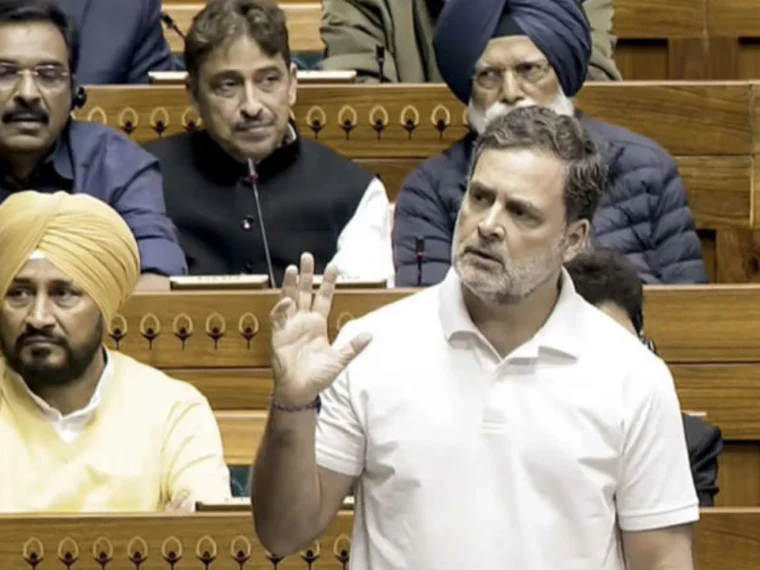
New Delhi — Congress leader and Leader of Opposition in the Lok Sabha, Rahul Gandhi, on Wednesday delivered a scathing critique of the Narendra Modi government during the Union Budget debate, alleging that the Prime Minister had compromised India’s sovereignty in the recently concluded India–US interim trade agreement.
Speaking in Parliament, Gandhi accused the government of conceding key national interests in the digital and agricultural sectors, framing the trade understanding as a one-sided arrangement that weakens India’s strategic and economic autonomy.
“You have done a trade deal,” Gandhi said during his address, arguing that the agreement undermines the pillars that could define India’s global standing in the 21st century. According to him, control over digital trade rules and data governance will be central to India’s ambition of becoming a technological and economic superpower.
Gandhi laid out several specific concerns regarding the digital provisions of the agreement. He alleged that the government had agreed to ease data localisation requirements, allow freer cross-border data flows to the United States, and limit the scope of digital taxation. He further claimed that companies operating under the agreement would not be required to disclose source code and that long-term tax concessions had been extended to large technology corporations.
“The thing that is going to transform India in the 21st century — our data — this is what the Modi government has given away,” Gandhi asserted, arguing that digital sovereignty is integral to economic independence.
Escalating his rhetoric, the Congress leader accused the government of compromising the country’s dignity and sovereignty. He described the agreement as a “surrender” and questioned whether national interests had been adequately protected in negotiations.
Beyond digital policy, Gandhi also raised concerns about the agricultural sector. He claimed that increased access for American agricultural products could negatively impact Indian farmers by intensifying competition in domestic markets. According to him, such provisions could place pressure on local producers already navigating economic challenges.
The Congress MP also referenced the textile industry, alleging that domestic manufacturing sectors had been adversely affected under the broader trade arrangement. He argued that key industries require stronger safeguards to remain competitive in the global market.
Framing the issue in strategic terms, Gandhi said the agreement reflects a broader shift in economic policy that places India in a weaker bargaining position. He maintained that data governance, regulatory authority, and taxation policies are critical levers for long-term national growth and technological leadership.
The Centre has positioned the India–US interim trade understanding as part of a broader effort to deepen economic cooperation with Washington, expand bilateral trade, and enhance market access for Indian businesses. Government representatives have emphasized the potential benefits of closer commercial ties, though detailed responses to Gandhi’s parliamentary remarks have not yet been publicly issued.
The debate highlights broader questions surrounding India’s evolving trade strategy, digital policy framework, and balancing of global economic partnerships with domestic priorities. As discussions continue, the trade agreement is likely to remain a focal point in political discourse, particularly regarding its long-term impact on data sovereignty, agriculture, manufacturing, and India’s global economic positioning.