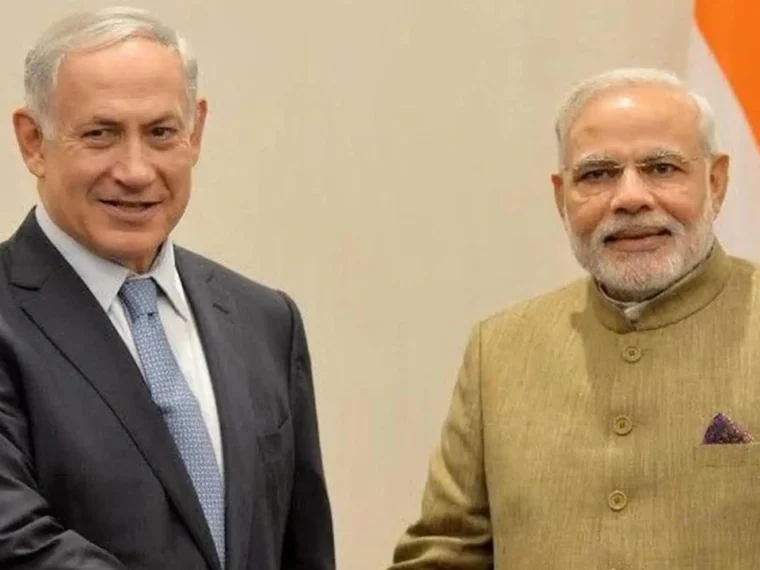
Jerusalem: Prime Minister Narendra Modi’s upcoming visit to Israel has become entangled in the country’s domestic political tensions, with opposition leader Yair Lapid threatening to boycott his parliamentary address unless Israel’s Supreme Court chief is invited in line with established protocol.
Modi is scheduled to arrive in Israel on February 25 for a two-day trip, during which he is expected to address the Knesset and hold meetings with Prime Minister Benjamin Netanyahu and President Isaac Herzog. The visit is being seen as a significant diplomatic engagement between two close strategic partners.
However, Lapid has insisted that Supreme Court President Yitzhak Amit be formally invited to attend Modi’s Knesset address, as is customary during speeches by visiting heads of government. According to opposition sources, their demand is not a call to boycott the Indian Prime Minister but rather an appeal to uphold parliamentary convention.
“We do not want India to be embarrassed by us,” Lapid said during a recent session of the Knesset. He warned that if the ruling coalition continued its boycott of the Supreme Court chief during the special session, opposition lawmakers would find it difficult to attend the debate. Lapid stressed that a half-empty parliament during Modi’s address would create “enormous embarrassment” for Israel.
The controversy is rooted in Israel’s ongoing judicial overhaul debate, which has deeply divided the country for more than two years. Mass protests erupted across Israel prior to the October 7 Hamas attack two years ago, with hundreds of thousands taking to the streets to oppose proposed changes to the judiciary.
Tensions intensified after Yitzhak Amit was elected President of the Supreme Court in January 2025. Justice Minister Yariv Levin has reportedly refused to recognise Amit’s authority as Chief Justice and has declined to meet or formally acknowledge him. His name has also not been published in the State Gazette as required by law, further escalating the dispute.
As a result, Amit has been excluded from several major Knesset events, including speeches by US President Donald Trump and other world leaders, where traditionally the Supreme Court head would be invited. Just weeks ago, the opposition boycotted a Knesset session marking its 77th anniversary due to Amit’s exclusion.
The latest standoff has triggered sharp exchanges within Israeli political circles. Knesset Speaker Amir Ohana accused Lapid of jeopardising Israel’s foreign relations for domestic political gains. In a post on X, Ohana said that harming ties with an important ally like India would be “an unfortunate, wrong choice” and described such threats as “illegitimate weapons in an internal political struggle.”
Ohana also questioned why the opposition did not boycott appearances by Argentine President Javier Milei or former US President Trump despite Amit’s absence from those events.
Lapid responded by calling on Netanyahu to intervene and instruct the Knesset Speaker to invite Amit in accordance with parliamentary protocol. He reiterated that the opposition had “no desire” to harm Israel’s diplomatic standing or its relationship with India but argued they were being “pushed into a corner.”
Opposition sources have maintained that they are not calling for a boycott of Modi’s address but are urging the government to avoid unnecessary embarrassment during a high-profile visit by a key strategic partner. They emphasised that the relationship between Jerusalem and New Delhi is widely valued across Israel’s political spectrum.
As Modi’s visit approaches, the controversy underscores how Israel’s internal political divisions—particularly over judicial reforms—continue to spill over into diplomatic affairs, potentially complicating what is intended to be a landmark engagement between two close allies.