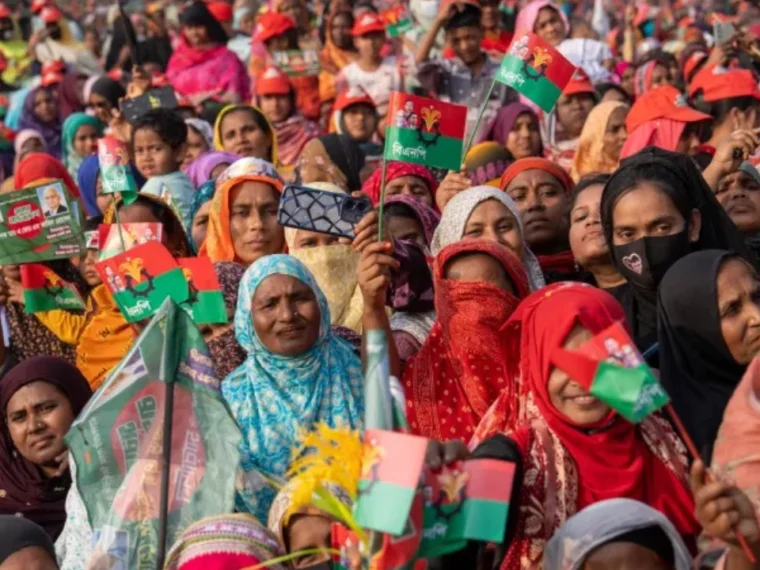
Bangladesh Election Results: A notable political shift has emerged in Bangladesh’s recent elections, with a large segment of minority Hindu voters rallying behind the Bangladesh Nationalist Party (BNP) while distancing themselves from Jamaat-e-Islami in several crucial constituencies.
Political observers and party insiders indicate that concerns over campaign rhetoric and ideological positioning played a major role in influencing minority voting patterns. Hindus, who constitute approximately 9 percent of Bangladesh’s population, appear to have consolidated their votes strategically to prevent Jamaat from expanding its political footprint.
Campaign Controversy and Minority Concerns
During the election campaign, several Jamaat leaders reportedly made remarks questioning certain Hindu religious practices. These statements sparked unease among minority communities and became a significant talking point in affected constituencies.
In response, many Hindu voters gravitated toward BNP leadership under Tarique Rahman. Analysts suggest that the consolidation of minority votes behind the BNP was not merely about endorsement but also about preventing Jamaat from gaining parliamentary strength.
The absence of the Awami League from the electoral contest further reshaped the dynamics. Supporters of former Prime Minister Sheikh Hasina reportedly shifted their votes toward the BNP as a strategic calculation.
According to a senior Awami League supporter who spoke anonymously, backing the BNP was viewed as a pragmatic move. The reasoning was that a BNP-led government would still allow space for the Awami League to remain politically relevant in the future — a scenario they believed less likely if Jamaat were to gain power.
Some voters also expressed apprehension over Jamaat’s perceived ideological leanings, which critics allege are aligned more closely with Pakistan — a stance that does not resonate well with a significant portion of the electorate.
Key Defeats for Jamaat Leaders
The election results reflected this broader shift. Several high-profile Jamaat figures suffered defeats in constituencies where minority voters played a decisive role.
In Khulna-5, Jamaat’s senior leader Mian Ghulam Parwar lost to BNP candidate Ali Lobi. The defeat of such a prominent figure was widely interpreted as a setback for Jamaat’s national ambitions.
Similarly, in Dhaka-3, BNP’s Hindu candidate Goyeshwar Chandra Roy secured victory over Jamaat alliance nominee Shahinur Islam. The result was seen as symbolic of the consolidation of minority votes behind BNP nominees.
In Khulna-1, another closely watched constituency with a sizable Hindu electorate, Jamaat’s Hindu candidate Krishna Nandi was defeated by a Muslim BNP candidate. Political analysts argue that this outcome highlights that religious identity alone did not determine voting choices. Instead, broader political concerns and ideological trust appeared to influence voter decisions.
Ripple Effects on Allied Parties
The impact of Jamaat’s electoral challenges extended to its allies. The National Citizens Party (NCP), which emerged from a recent student-led movement and aligned itself with Jamaat, also experienced setbacks.
Although party president Nahid Islam managed to retain his seat, other prominent leaders, including Sarjis Islam from Panchagarh-1, faced defeats. Observers believe the alliance with Jamaat may have contributed to voter hesitation in certain constituencies.
A Strategic Realignment
Overall, the election results suggest a strategic realignment among Bangladesh’s minority voters. With the Awami League absent and Jamaat seeking expanded influence, many voters appear to have opted for what they considered the most viable alternative.
While BNP’s gains reflect immediate electoral success, the broader implications for Bangladesh’s political future remain to be seen. What is clear, however, is that minority voting patterns played a pivotal role in shaping the outcome of key contests — and may continue to influence the country’s evolving political landscape.