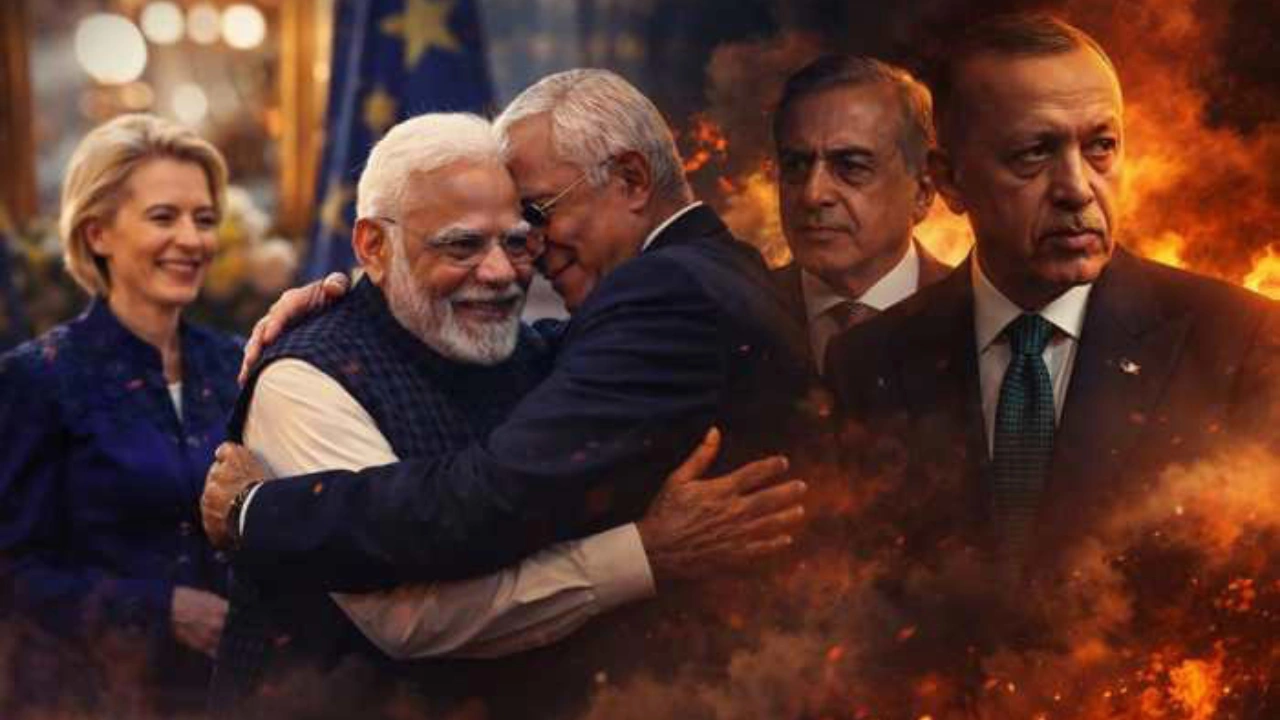
India–EU Trade Deal: India’s landmark trade agreement with the European Union is reshaping regional and global trade equations, with its impact extending far beyond Brussels and New Delhi. While the deal promises significant gains for both India and the EU, it is also expected to adversely affect countries such as Turkey, Bangladesh, and Pakistan—each for different strategic and economic reasons.
Under the agreement, tariffs on more than 90 per cent of EU exports to India will either be eliminated or substantially reduced. This includes steep duties of up to 44 per cent on machinery, 22 per cent on chemicals, and 11 per cent on pharmaceuticals, most of which will be phased out over time. Duties on EU beer will be cut to 50 per cent, while tariffs on aircraft, spacecraft, and several chemical products will be eliminated almost entirely.
According to EU estimates, the agreement could double European exports to India by 2032 and generate annual duty savings of nearly €4 billion for European companies. While this strengthens India’s position as a key global trade partner, it also threatens the competitive advantage enjoyed by several countries that previously benefited from preferential access or strategic loopholes.
Impact on Turkey
India–Turkey relations have remained strained since Operation Sindoor, following Ankara’s military support to Pakistan through drones and loitering munitions. The India–EU trade pact is now poised to create fresh economic challenges for Turkey.
Under the EU–Turkey Customs Union, Ankara is required to align its external tariffs with those of the European Union. This means that when the EU lowers tariffs for a free trade partner like India, Turkey must follow suit—without receiving reciprocal access to the Indian market. Ankara has repeatedly raised concerns over this structural imbalance, but no meaningful resolution has been achieved so far. As a result, Turkish manufacturers could lose competitiveness both at home and in EU-linked markets, making Turkey one of the indirect casualties of the deal.
Impact on Bangladesh
Bangladesh has long benefited from duty-free access to the European Union as a Least Developed Country (LDC), giving it a significant edge over Indian exporters, especially in textiles and garments. This advantage helped Dhaka capture nearly $30 billion worth of the EU apparel market, while India’s exports remained comparatively limited due to higher tariffs.
However, the India–EU agreement is set to change this dynamic. Commerce Minister Piyush Goyal recently stated that India’s textile exports to Europe could rise from $7 billion to $30–40 billion in a relatively short period. With Indian garments now competing on both price and quality, Bangladesh’s market share in the EU is expected to shrink, particularly as India scales up manufacturing and supply chains.
Impact on Pakistan
Pakistan, already grappling with a fragile economy, has reacted uneasily to India’s deepening ties with the European Union. The agreement has also unsettled Pakistan-backed Khalistani groups operating in Europe, who fear that closer India–EU cooperation will give New Delhi greater leverage to counter their activities.
The India–EU partnership extends beyond trade, encompassing defence collaboration and anti-terror cooperation. This creates additional pressure on extremist networks based in countries such as Germany, the UK, and Canada. Meanwhile, the United States has also expressed quiet displeasure, as its own trade negotiations with India remain stalled.
Despite sustained pressure from former US President Donald Trump, India has refused to concede to unfavourable terms. The EU–India deal now places Washington under greater scrutiny, as the US risks being left out of a major strategic and economic partnership.