
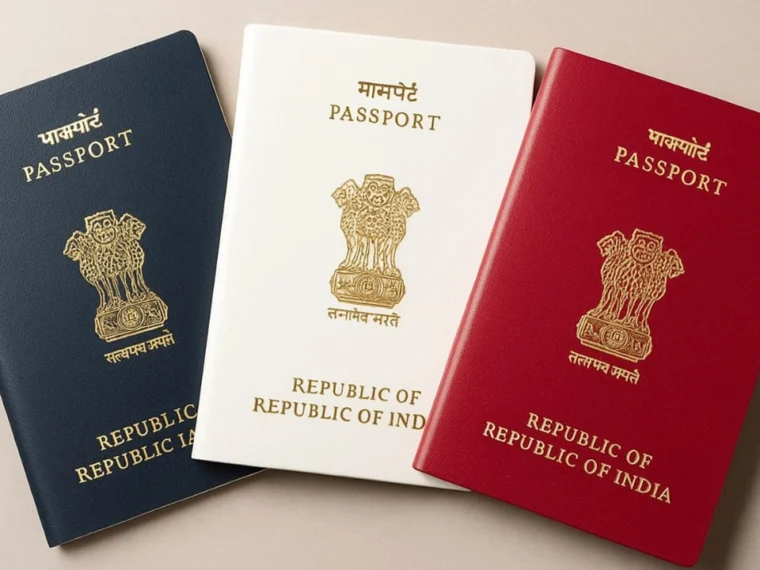
India’s global travel mobility has received a notable boost in 2026, as the Indian passport climbed 10 places to secure the 75th rank in the latest Henley Passport Index. The improvement marks a significant step forward for Indian travellers, expanding their global access and strengthening India’s international mobility standing.
According to the 2026 edition of the Henley Passport Index, Indian passport holders now enjoy visa-free or visa-on-arrival access to 56 destinations worldwide. This improvement highlights steady progress compared to previous years. In 2025, India ranked 85th, while it stood at 80th in 2024 and 84th in 2023. The lowest ranking in recent years came in 2021, when India was placed at 90th position.
Global Rankings Overview
The Henley Passport Index ranks 199 passports based on access to 227 destinations worldwide. The ranking system is derived from data provided by the International Air Transport Association (IATA). A passport earns one point if its holder can enter a destination without a prior visa, obtain a visa on arrival (VOA), secure an electronic travel authorisation (ETA), or receive a visitor’s permit upon arrival. If travellers must apply for a visa before departure or require prior government approval, the passport receives zero points.
In 2026, Singapore retained its position as the world’s most powerful passport, offering visa-free access to 192 countries. Japan secured the second spot with access to 187 destinations, followed closely by South Korea with 186 destinations. At the bottom of the list is Afghanistan, with visa-free access to just 24 countries.
A lower numerical ranking in the Index signifies stronger passport power and greater ease of international travel.
56 Visa-Free Countries for Indian Passport Holders
Indian travellers can now visit the following 56 destinations without obtaining a pre-arrival visa:
Angola, Barbados, Bhutan, British Virgin Islands, Burundi, Cambodia, Cape Verde Islands, Comoro Islands, Cook Islands, Djibouti, Dominica, Ethiopia, Fiji, Grenada, Guinea-Bissau, Haiti, Indonesia, Jamaica, Jordan, Kazakhstan, Kenya, Kiribati, Laos, Macao (SAR China), Madagascar, Malaysia, Maldives, Marshall Islands, Mauritius, Micronesia, Mongolia, Montserrat, Mozambique, Myanmar, Nepal, Niue, Palau Islands, Philippines, Qatar, Rwanda, Samoa, Senegal, Seychelles, Sierra Leone, Sri Lanka, St. Kitts and Nevis, St. Lucia, St. Vincent and the Grenadines, Tanzania, Thailand, The Gambia, Timor-Leste, Trinidad and Tobago, Tuvalu, Vanuatu, and Zimbabwe.
These destinations span Asia, Africa, the Caribbean, and Oceania, providing Indian citizens with diverse travel options ranging from tropical island getaways to cultural heritage experiences.
What This Means for Indian Travellers
The jump in ranking reflects gradual improvements in diplomatic relations and bilateral agreements between India and other nations. Enhanced travel access benefits not only tourists but also business professionals, students, and entrepreneurs seeking international opportunities.
However, it is important to note that visa-free does not always mean unrestricted entry. Some destinations may impose conditions such as limited duration of stay, return ticket requirements, or proof of sufficient funds.
Overall, the rise in India’s passport ranking signals positive momentum in global mobility. As international travel continues to evolve, further diplomatic efforts and travel agreements could strengthen India’s position even more in the coming years.
The 2026 ranking is a reminder that while India still has room for growth compared to leading nations, steady progress is underway — offering Indian travellers broader horizons and greater global connectivity.