
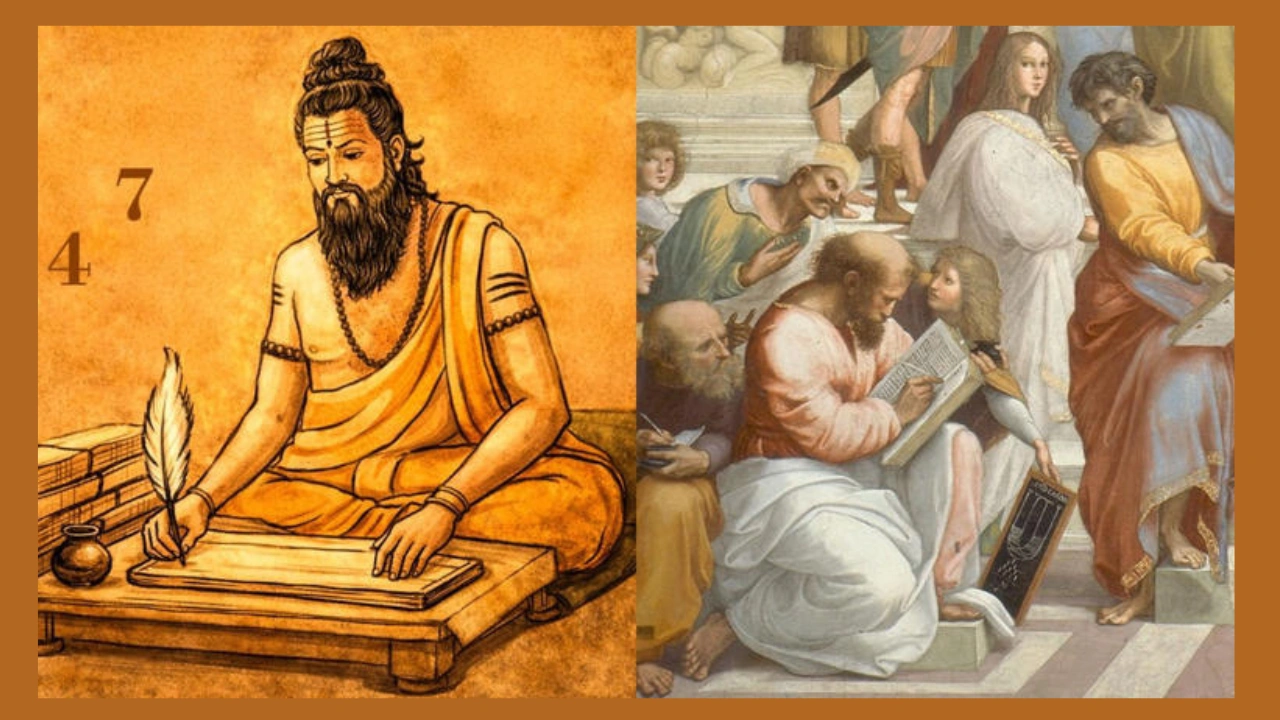
Pythagorean Theorem Origin
Pythagorean Theorem Origin: For generations, students across the world have memorised the familiar formula: a² + b² = c². It is introduced in classrooms as the Pythagorean Theorem, named after the Greek philosopher Pythagoras, who lived around 500 BCE. The story presented in most textbooks is simple — Pythagoras discovered the relationship between the sides of a right-angled triangle.
But historical evidence suggests the origins of this theorem may lie centuries earlier, far from Greece.
The Indian Connection: Shulba Sutras
Long before Pythagoras was born, ancient Indian scholars had already documented the same geometric principle. The evidence appears in the Shulba Sutras, a collection of Sanskrit texts composed between 800 BCE and 500 BCE. These texts were practical manuals that explained how to construct precise fire altars for Vedic rituals.
Among the earliest authors of these texts was the sage Baudhayana (c. 800–740 BCE). In his writings, Baudhayana clearly described the mathematical rule equivalent to a² + b² = c². His verse states that the area produced by the diagonal of a rectangle equals the sum of the areas produced separately by its length and breadth — essentially the Pythagorean Theorem expressed in words.
This documentation predates Pythagoras by at least two centuries.
Later scholars such as Katyayana refined and clarified this geometric principle even further. Their formulations closely resemble the modern version taught in schools today.
Geometry Rooted in Ritual Practice
The geometry described in the Shulba Sutras was not abstract theory. It was applied mathematics. Constructing Vedic fire altars required extreme precision because even minor miscalculations were considered ritual errors. Indian mathematicians used ropes and measuring tools — a rope-and-peg method — to create accurate geometric shapes including squares, rectangles, trapezoids and circles.
The Shulba Sutras also contain advanced approximations, including a remarkably accurate value of √2 calculated to five decimal places. Such precision demonstrates a sophisticated mathematical tradition that existed well before classical Greek geometry emerged.
What About Pythagoras?
While Pythagoras is widely credited in Western tradition, there is no surviving written work directly authored by him. His teachings were passed down through followers in a semi-secret philosophical community. Historians acknowledge that details about his life and discoveries are often debated.
In contrast, India preserved written mathematical manuscripts continuously — from Baudhayana and Katyayana to later scholars like Aryabhata.
Modern researchers, including Abraham Seidenberg and Kazuo Hayashi, have studied parallels between early Indian geometry and later Greek mathematical works. Some scholars suggest that mathematical ideas may have travelled from East to West over time.
Colonial Influence on Historical Credit
During the colonial period, Western scholars often categorised Indian mathematical texts as religious or ritualistic rather than scientific. As a result, the Shulba Sutras were treated as priestly manuals instead of rigorous mathematical works. Meanwhile, Greek contributions were elevated as foundational to global mathematics.
This imbalance influenced how mathematical history was written and taught worldwide. Over time, the theorem became universally associated with Pythagoras, while earlier Indian contributions remained largely unacknowledged in mainstream education.
A Broader Historical Context
It is worth noting that ancient civilizations such as Egypt and Babylon also demonstrated knowledge of similar geometric relationships. However, surviving evidence from these regions is limited compared to the detailed instructions found in the Shulba Sutras.
The debate, therefore, is not about denying Greek contributions to mathematics. Instead, it is about recognising that the geometric principle attributed to Pythagoras was known and documented in India centuries earlier.
Rethinking Mathematical History
The question today is not merely about renaming a theorem. It is about acknowledging a broader and more accurate global history of mathematics. Ancient India developed advanced geometric knowledge nearly 3,000 years ago, driven by practical, architectural and spiritual needs.
Recognising the role of the Shulba Sutras and scholars like Baudhayana and Katyayana does not diminish Greek achievements. Rather, it enriches our understanding of how mathematical knowledge evolved across civilizations.
History is most powerful when it is complete. The story of the Pythagorean Theorem may be more global — and older — than many classrooms have long suggested.
About the Author