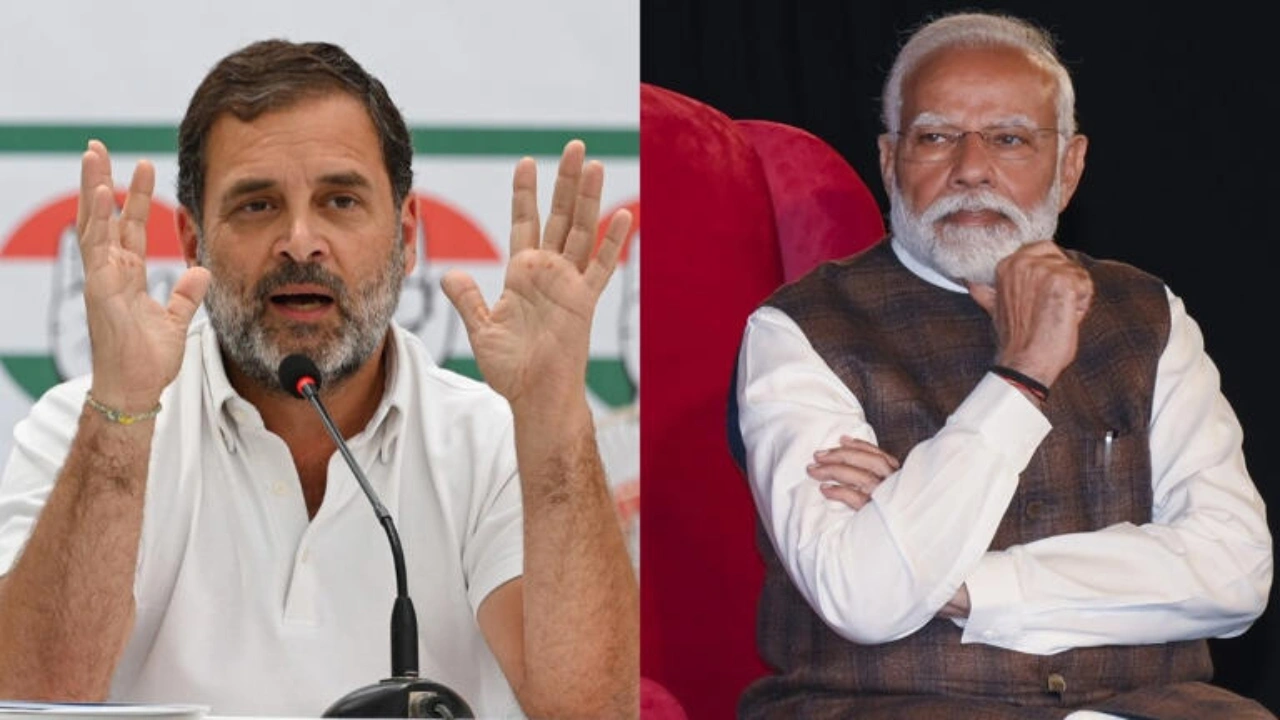
Rahul Gandhi
Prime Minister Narendra Modi continues to dominate India’s prime ministerial preference rankings, even as Congress leader Rahul Gandhi records steady and notable gains, according to the latest India Today–CVoter Mood of the Nation (MOTN) survey released in January 2026.
The findings underline a political landscape marked by continuity at the top, gradual shifts in voter perception, and contrasting fortunes for the Bharatiya Janata Party (BJP) and the Congress as the country looks ahead to the next Lok Sabha elections.
PM Preference: Modi Strengthens Lead, Rahul Shows Momentum
The survey places Narendra Modi firmly ahead as the most preferred candidate for prime minister, with 55 per cent of respondents backing him for the top post. This represents a clear upward trend from 52 per cent in August 2025 and 49 per cent in August 2024, reaffirming Modi’s enduring appeal after more than a decade in national leadership.
Rahul Gandhi, while still far behind Modi, continues to build momentum. The Congress leader is now preferred by 27 per cent of respondents, up from 25 per cent in the previous survey and a dramatic rise from just 7 per cent in January 2022. The trend data reflects a steady improvement in Gandhi’s personal standing over the last four years, suggesting that his sustained political visibility and outreach efforts are resonating with a broader section of voters.
Despite this rise, the gap between the two leaders remains substantial, highlighting Modi’s entrenched dominance in the national imagination even as the opposition shows signs of consolidation around a single face.
Electoral Projections: BJP Regains Momentum, Congress Loses Ground
The MOTN survey also offers a snapshot of how current voter sentiment could translate into parliamentary numbers if Lok Sabha elections were held today. According to projections, the BJP is set to win 287 seats, marking a gain of 27 seats compared to August 2025 and a strong recovery from its 240-seat tally in the 2024 general election.
In contrast, the Congress is projected to secure just 80 seats, a drop of 17 seats from the previous survey and significantly lower than its 99-seat performance in 2024. Other parties and regional formations together are expected to win 176 seats, down by 10.
These numbers suggest that while the BJP has regained political momentum and consolidated its base, the Congress has struggled to sustain the gains it made in the aftermath of the 2024 elections.
Modi’s Performance Ratings Remain Consistent
Public approval of Prime Minister Modi’s performance remains largely stable despite ongoing economic pressures and governance challenges. In January 2026, 57 per cent of respondents rated his performance as “good,” a marginal dip from 58 per cent in August 2025 and 59 per cent in August 2024.
Those who rated his performance as “average” stood at 16 per cent, while 24 per cent described it as “poor.” The near-flat movement in these numbers over the past year indicates a resilient approval base that has shown limited volatility.
Rahul Gandhi: Growing Acceptance, Limited Translation into Seats
Rahul Gandhi’s improving preference ratings reflect his increasing visibility on national issues and his efforts to project himself as a credible alternative to Modi. His near fourfold rise in PM preference since 2022 points to expanding acceptance beyond the Congress’s traditional support base.
However, the survey indicates that this personal popularity has yet to convert into proportional electoral success for the Congress. Organisational weaknesses, leadership challenges at the state level, and unresolved alliance dynamics continue to limit the party’s ability to capitalise on Gandhi’s improved standing.
Outlook
The January 2026 MOTN survey paints a picture of political continuity with gradual undercurrents of change. Modi remains the undisputed frontrunner for prime minister, while Rahul Gandhi’s upward trajectory signals a slow but steady reshaping of opposition leadership perceptions. Whether this shift can translate into electoral gains for the Congress remains the key question as India’s political cycle moves forward.
About the Author