
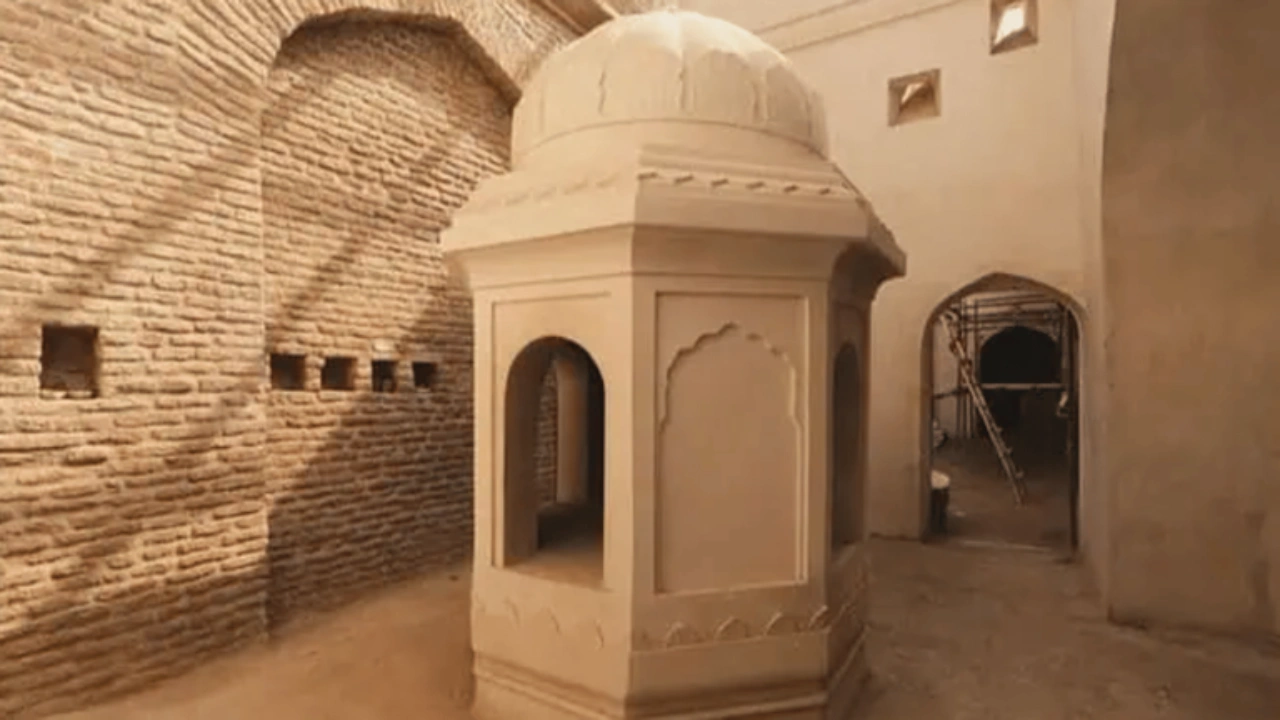
At a time when India–Pakistan relations remain strained, Pakistan has completed the restoration of an ancient Hindu temple located within the historic Lahore Fort and reopened it to the public. The restored shrine, known as the Loh Temple, is dedicated to Lava (also called Loh or Luv), the elder son of Lord Ram, and holds deep religious as well as cultural significance in Hindu tradition.
The conservation work has been carried out by the Walled City of Lahore Authority (WCLA) in collaboration with the Aga Khan Cultural Service–Pakistan. Alongside the Loh Temple, authorities have also preserved key Sikh-era structures within the fort complex, including the Hammam and the Athdara Pavilion associated with Maharaja Ranjit Singh, the founder of the Sikh Empire.
The Loh Temple is situated inside the Lahore Fort, a UNESCO World Heritage Site in Pakistan’s Punjab province. Architecturally, the temple consists of several interconnected chambers and features an open-to-sky layout with a memorial shrine at its center. Though relatively small in size, the temple carries immense historical value, reflecting the religious diversity that once shaped the region.
According to WCLA officials, the conservation project aimed to stabilize the structure, preserve its original features, and protect it from further deterioration. While partial restoration work had been undertaken in 2018, the latest phase marks the completion of the temple’s full conservation, allowing visitors once again to access the site.
The temple is closely linked to ancient Hindu legends surrounding the origins of Lahore. Hindu belief holds that the city derives its name from Lava, Lord Ram’s elder son. The temple is therefore also referred to as the Lava Temple. Historical and mythological texts suggest that Lahore was once known as “Lavapuri” or “Lavpor,” meaning the city of Lava.
Ancient references further reinforce this association. In the Deshwa Bhaga, the city is described as Lavpor, while Rajputana-era annals mention the fort as “Loh Kot,” translating to “the fort of Loh.” These names are believed to honor Lava as the founder of the city. According to legend, while Lava established Lahore, his twin brother Kusha founded the nearby town of Kasur, which still exists in Pakistan today.
Despite political tensions between India and Pakistan, cultural heritage experts view the restoration as a significant step toward preserving shared history. The Lahore Fort itself reflects centuries of layered history, having been shaped by Hindu, Muslim, Sikh, and British influences. Within its walls stand monuments that testify to the region’s complex past, where multiple faiths and empires once coexisted.
In addition to the Loh Temple, the recently conserved Sikh-era structures highlight the importance of Maharaja Ranjit Singh’s legacy in Lahore. The Athdara Pavilion and the Hammam, both dating back to the Sikh period, are key architectural remnants from a time when Lahore served as the capital of the Sikh Empire. Their preservation is seen as part of broader efforts to protect monuments associated with minority communities.
Officials involved in the project have emphasized that heritage conservation is not limited by contemporary politics. Instead, it focuses on safeguarding monuments that belong to humanity’s shared cultural inheritance. By reopening the Loh Temple, authorities hope to promote historical awareness and encourage visitors to explore Lahore Fort’s diverse religious and cultural layers.
For historians and devotees alike, the restoration of the Loh Temple is a reminder that Lahore’s roots stretch far beyond modern borders. The temple’s continued presence within the fort stands as a symbol of ancient traditions, enduring legends, and the need to preserve history, even amid ongoing geopolitical challenges.